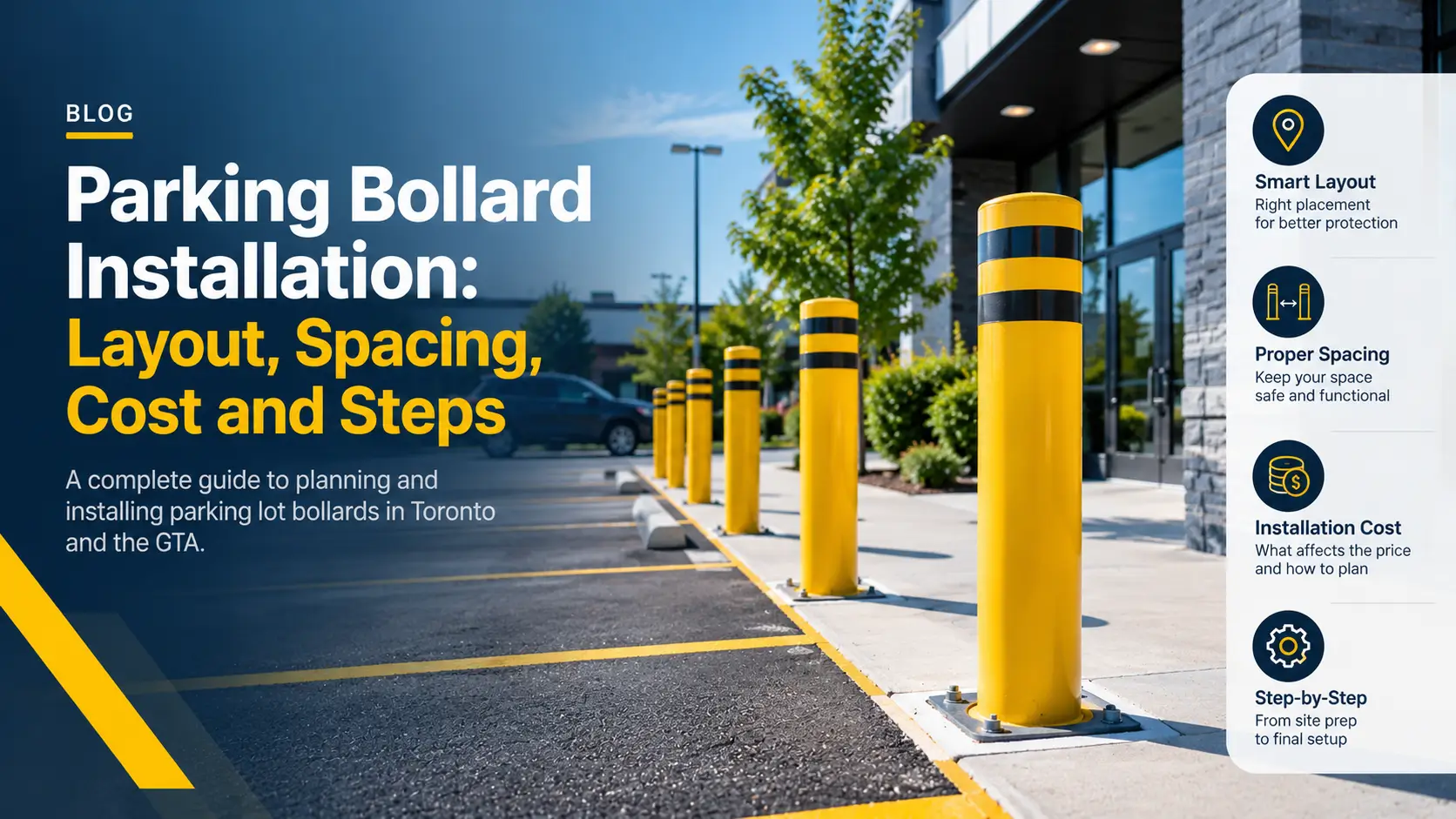
Parking bollard installation means placing steel posts where vehicles meet people, buildings or equipment, then anchoring them so they stay put. Done well, a parking lot gets clear walkways, protected storefronts and meters, and fewer bumper-height repair bills. We Are Bollards plans, supplies and installs parking bollards across Toronto and the GTA, from a single reserved stall to a full lot.
This guide covers what a property manager needs before asking for quotes:
- Where bollards go in a parking lot
- How far apart to space them, including Ontario accessibility rules
- Which bollard type and mounting suits each spot
- What drives parking bollard installation cost
- How the installation works, step by step
Parking Lot Bollard Layout: Where Bollards Go
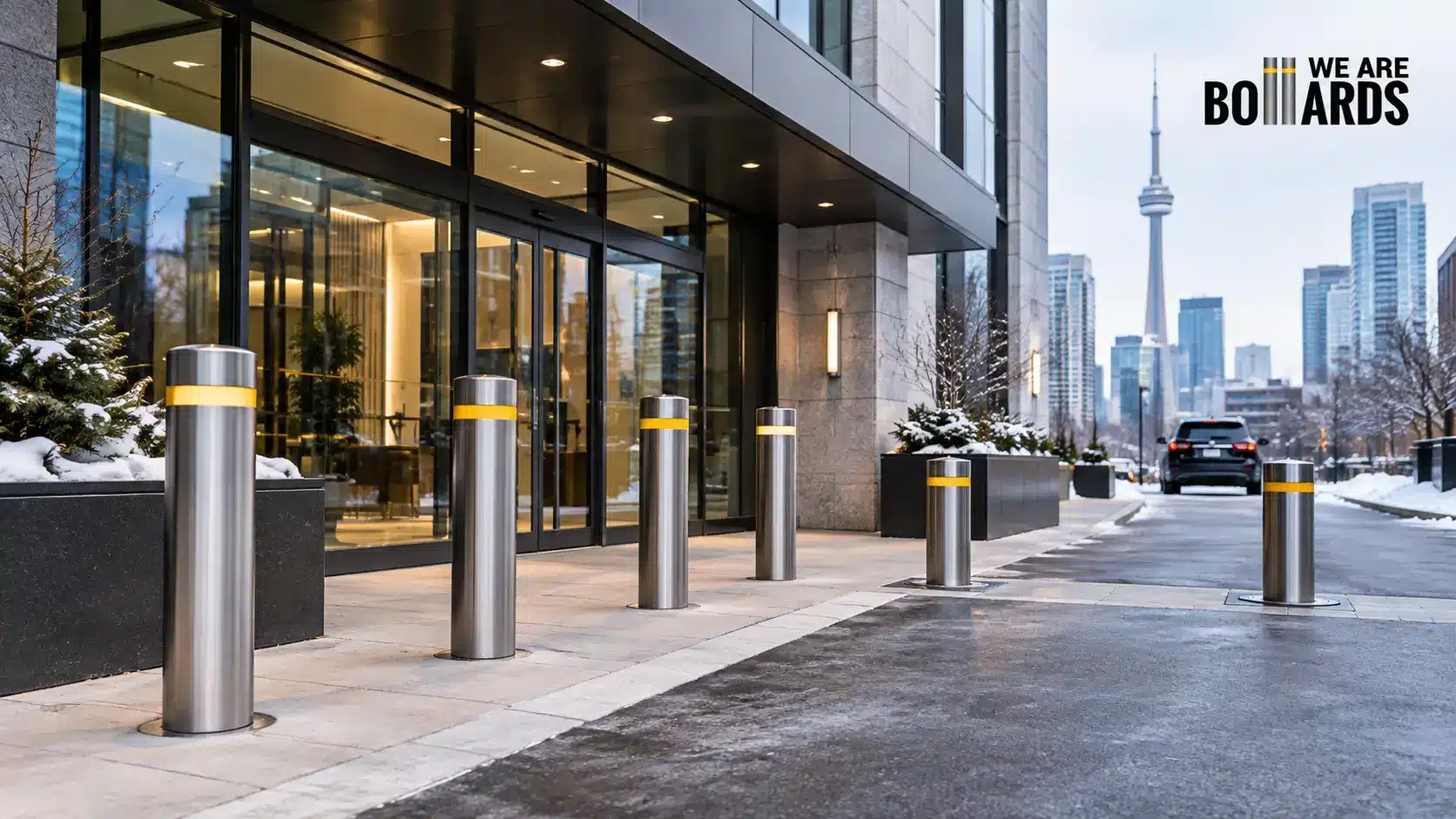
Start the layout with what a car could hit, not with how many posts the budget allows. Walk the lot and mark every point where a vehicle pulling in, backing out or sliding on ice could reach something it shouldn’t.
| Location in the lot | What the bollards protect | Typical bollard choice |
|---|---|---|
| Head-in stalls facing a storefront or entrance | Glass, doors and people on the sidewalk | Fixed bollards in a continuous row |
| Pedestrian walkways and crossings | People moving between cars and the building | Fixed or bolt-down, spaced for wheelchairs |
| Gas meters, transformers, EV chargers, pay stations | Equipment that is costly or dangerous to hit | Fixed bollards on each exposed side |
| Drive-thru lanes and tight corners | Building corners, menu boards, curbs | Fixed bollards with bollard covers |
| Parking garage columns and ramps | Structure, sprinkler lines, walls | Bolt-down bollards |
| Reserved, visitor or accessible stalls | The space itself | Manual retractable or foldable bollards |
| Lane edges and stall ends | Traffic flow, line of sight | Flexible delineator posts or curb stops |
| Fire routes and service access | Access that must stay open to some vehicles | Removable or battery-powered automatic bollards |
Three layout habits save trouble later:
- Keep fire routes and snow-clearing paths in mind. Ploughs need room to pass and a place to push snow. A post in the wrong spot gets hit every winter.
- Leave room for car doors. Set bollards about 1.5 ft (0.45 m) back from the curb face beside parked cars so doors can open.
- Mark it before anyone digs. We paint each bollard position on site so you can see the finished layout and adjust it before work starts.
How Far Apart Should Parking Bollards Be?
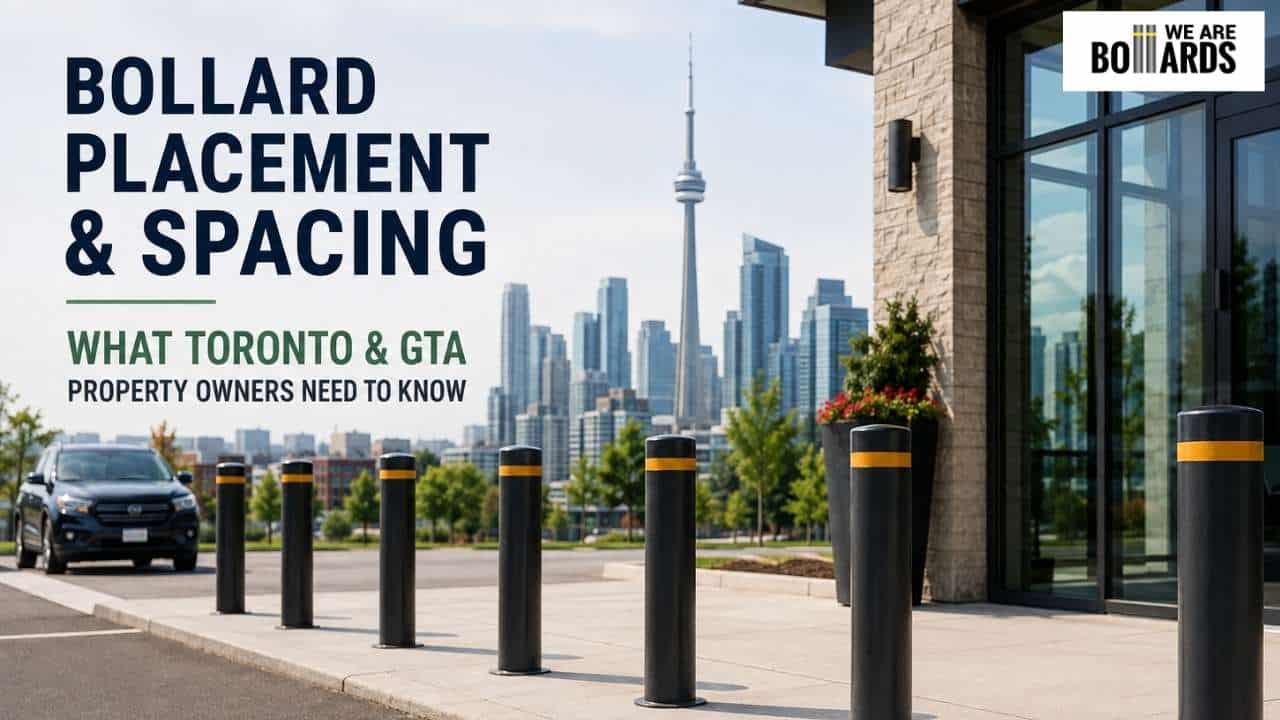
For most parking lots, space bollards so the clear gap between them is 3 to 5 ft (about 0.9 to 1.5 m). Wider than 5 ft and a small car can slip through. Narrower than 3 ft and wheelchairs, strollers and walkers struggle to pass. Measure the gap from the widest point of each post, including any cover.
| Situation | Clear gap / distance | Why |
|---|---|---|
| Storefront or entrance row | 3–4 ft (0.9–1.2 m) | Blocks cars, lets people through |
| Walkway or path entrance | At least 850 mm (about 33.5 in) | Ontario minimum for path entrance openings |
| Around meters, chargers, utilities | As tight as needed | No foot traffic needs to pass |
| Lane guidance with flexible posts | 5–6 ft (1.5–1.8 m) or more | Guides drivers rather than stopping them |
| Distance from a building entrance | About 3–5 ft (0.9–1.5 m) | Stops the vehicle before the wall or door |
| Setback from the curb beside parked cars | About 1.5 ft (0.45 m) | Room for car doors |
Ontario accessibility rules (AODA)
Much of the spacing advice online quotes the US ADA. In Ontario, the reference is the Design of Public Spaces standard under the AODA (O. Reg. 191/11). For new or redeveloped exterior paths of travel, it calls for a minimum clear width of 1,500 mm on the path and a minimum clear opening of 850 mm at a path entrance, whatever gate or bollard design is used. It applies to obligated organizations, and municipal standards can be stricter. If your site falls under it, we lay out bollards so every pedestrian gap meets the minimum while still blocking vehicles.
Choosing Parking Bollards: Type and Mounting
The right parking bollard depends on two questions: does any vehicle ever need to pass, and what is under the surface?
| Bollard type | Best for | Mounting | Vehicle access |
|---|---|---|---|
| Fixed bollards | Storefronts, meters, walkways | Embedded in a concrete footing; custom diameter and height | Never |
| Bolt-down bollards | Garages, existing slabs, loading bays | Surface-mounted on an 8 × 8 in base plate with anchor bolts; 4.5, 5.5 or 6.6 in diameter; 24–60 in tall | Never (can be unbolted and moved) |
| Manual retractable bollards | Reserved stalls, service lanes | Sleeve set in the ground; post lowers by key | When lowered |
| Battery-powered automatic bollards | Gated access, frequent openings | Sleeve set in the ground; battery-powered | By remote |
| Flexible delineator posts | Lane edges, stall marking (“parking posts”) | Surface-mounted | Bends on impact; guides only |
Embedded or bolt-down? An embedded fixed bollard set in concrete gives the most impact resistance. A bolt-down bollard installs faster and avoids excavation, but it is not as strong as an in-ground post. It is the usual choice on a parking garage deck, where digging is not possible.
Finish for Toronto winters. Road salt is hard on steel. Our fixed bollards come powder-coated or galvanized, and we recommend a bollard cover to protect the finish and keep the colour bright for drivers. Our retractable bollards are rated to -40°C and resist water, ice and dust.
Parking Bollard Installation Cost
Parking bollard installation cost depends on the bollard type, the surface we cut through and how many posts go in. Every lot is different, so we price each project after a free site visit. Contact We Are Bollards for a written quote: we offer the best prices in the industry, and if you find a lower quote elsewhere, we’ll beat it by 3%.
| Bollard and mounting | Relative cost | What drives it |
|---|---|---|
| Flexible delineator post, surface-mounted | Lowest | Light post, quick anchoring, no digging |
| Bolt-down steel bollard on existing concrete | Low to moderate | Steel post and anchors, no footing |
| Fixed steel bollard, embedded in a new footing | Moderate | Cutting, digging, concrete and patching |
| Manual retractable bollard | Higher | Ground sleeve, locking post, footing |
| Battery-powered automatic bollard | Highest | Motorized unit, remote control, footing |
| Bollard cover (add-on) | Small add-on | Protects the finish and adds visibility |
What changes the price
- Number of bollards. Getting the crew and equipment to site is a fixed cost. Ten bollards in one visit cost less each than two.
- Surface. Cutting asphalt is quicker than coring thick concrete. Patching interlock or decorative paving adds time.
- Footing size. Deeper, wider footings use more concrete and more digging. Clay soil and frost push depth up in the Toronto area.
- What is underground. Buried lines can force a position change or hand digging.
- Height, diameter and finish. Larger pipe, stainless steel, galvanizing and covers all add to material cost.
- Access and timing. Working around open businesses or after hours can add labour time.
How to budget a parking lot project
- Count the protection points from the layout table above.
- Multiply by your spacing to get the number of posts in each row.
- Group posts by type and mounting.
- Book a free site visit so we can confirm the surface, depth and final count in a written quote.
How Parking Lot Bollard Installation Works
An embedded parking bollard installation follows eight steps. Bolt-down bollards skip the digging and concrete work, so they are usually done in a single visit.
- Site assessment and quote. We walk the lot with you, confirm what needs protecting, and measure spacing and setbacks.
- Layout marking. Each bollard position is marked on the pavement so you can approve the layout before work starts.
- Utility locates and permits. Before any digging in Ontario, underground lines are located through Ontario One Call. If a bollard sits on municipal land, such as a city boulevard, the municipality’s approval is needed. We help with permits.
- Cutting the surface. We saw-cut or core the asphalt or concrete at each mark.
- Digging the footing. Holes are augered or dug to the depth the site needs. In the Toronto area, the building code uses 1.2 m (4 ft) as the frost depth for foundations, and clay soils heave, so footing depth is set for frost. See our post hole digging service.
- Setting and pouring. Each bollard is set plumb and in line, then concrete is poured around it. Steel pipe bollards are filled with concrete for extra strength.
- Curing and patching. Vehicles stay off the new footings for [___ hours]. The surface around each post is then patched and finished.
- Covers and final check. Covers go on, each bollard is checked for plumb and spacing, and we walk you through care. Fixed bollards need little more than an occasional clean.
Bolt-down installation: we drill anchor holes in sound concrete, fix the base plate with anchor bolts, and check alignment. On a parking garage deck, we confirm what is inside the slab before drilling.
How long it takes: most bollard installations take a few hours. A larger parking lot run usually takes a day or two, depending on the count and the surface.
Parking Bollard Installation in Toronto and the GTA
We Are Bollards is based in Vaughan and installs parking bollards for plazas, office and condo lots, warehouses and places of worship across Toronto and the GTA. That includes North York, Scarborough, Etobicoke, Mississauga, Brampton, Vaughan, Markham and Richmond Hill. Local lots bring local problems: salt, plough damage, frost heave in clay soil and busy plazas that can’t close. We plan around all of them. Every bollard carries a 1-year warranty.
If you only need a few posts at a home or storefront, see fixed bollard installation in Toronto or retractable bollard installation.
Planning a parking lot project? Call (647) 964-3020 or request a free site quote. Send a site plan or a few photos and we’ll come back with a layout and the industry’s best price.
Parking Bollard Installation FAQs
How much does parking bollard installation cost?
It depends on the bollard type, the surface and how many posts you need. Fixed embedded bollards take more work than bolt-down or flexible posts, and larger orders cost less per bollard. Contact We Are Bollards for a free site quote; we offer the industry’s best prices and beat any lower quote by 3%.
How far apart should parking bollards be?
Keep a clear gap of 3 to 5 ft (0.9 to 1.5 m) between posts. That stops cars but lets people through. Where Ontario’s AODA applies, pedestrian path entrances need at least 850 mm clear.
How deep are parking bollards installed?
It depends on the bollard, the soil and the job it does. In the Toronto area, frost and clay soil usually mean a deeper footing than you’d expect. We confirm depth at the site visit. [Add your standard depth and hole diameter here.]
Can bollards be installed in an existing parking lot?
Yes. We cut through the asphalt or concrete at each position, install the bollard, and patch around it. On a concrete deck where digging isn’t possible, we use bolt-down bollards.
What is the difference between a parking bollard and a parking post?
“Parking post” usually means a lighter post that marks a stall or reserves a space, such as a flexible delineator or a fold-down post. A bollard is a heavier steel post built to stop or deter a vehicle.
Do I need a permit to install parking bollards in Toronto?
On your own private lot, often not, but it depends on the location and municipality. Bollards on city property, such as a boulevard, need municipal approval. Utility locates are needed before any digging. We help with permits.
How long does parking bollard installation take?
Most installs take a few hours. A full parking lot run usually takes a day or two.
Will parking bollards hold up in Toronto winters?
Yes. Our retractable bollards are rated to -40°C, and fixed bollards come powder-coated or galvanized against salt. A cover keeps them visible and protects the finish.