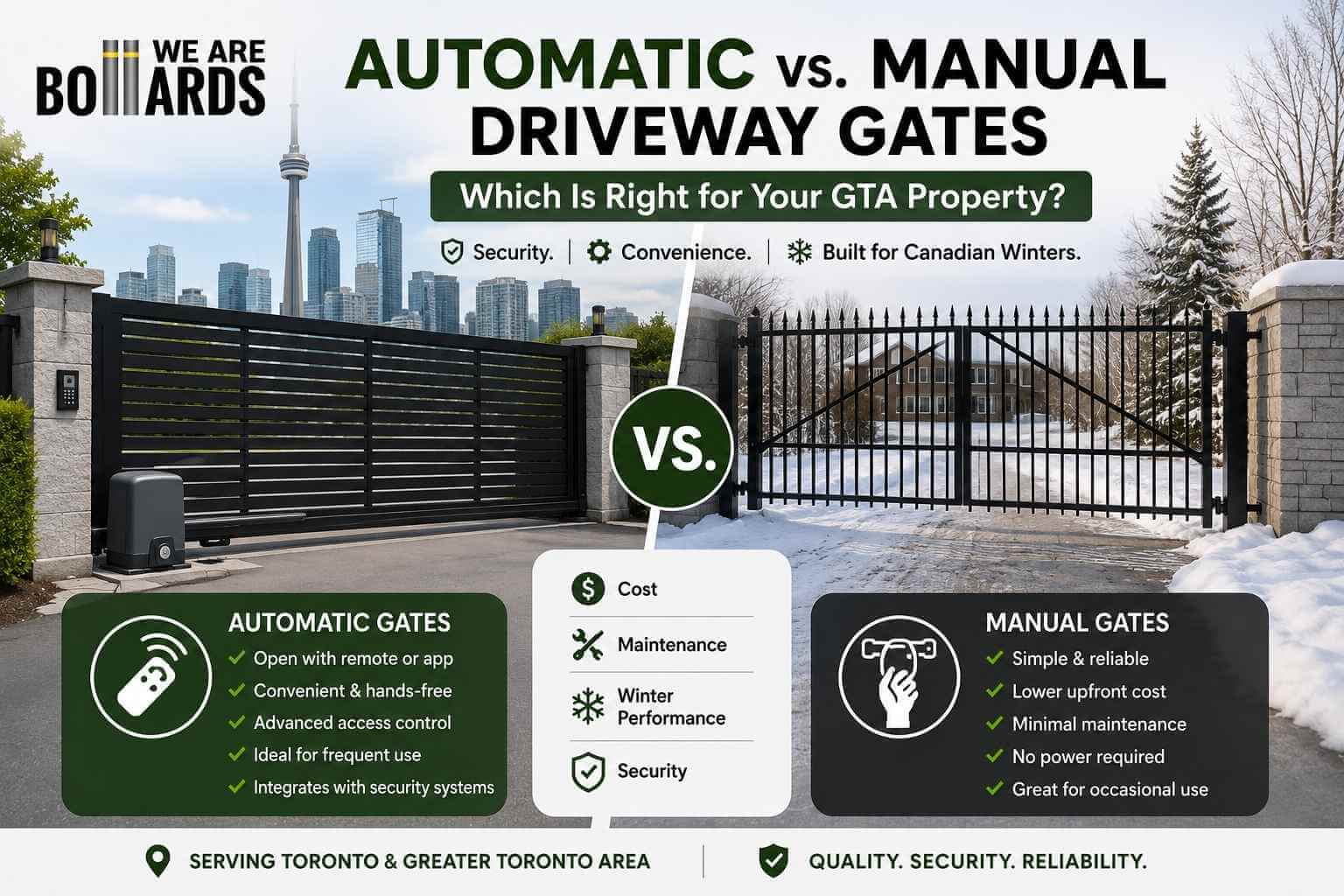
If you open your gate several times a day, or more than one person uses the driveway, an automatic gate is worth the extra cost. If you only open your gate now and then, a manual gate is simpler, cheaper, and has less that can go wrong. Neither one is “better” overall — it depends on how you actually use your driveway.
Below, we walk through everything you need to know to make that choice for a home or business in Toronto or the GTA — including how each gate type handles our winters, which most guides skip.
Automatic vs. Manual Gates: Quick Comparison
| Automatic Gate | Manual Gate | |
|---|---|---|
| Cost to install | Higher (gate + motor + wiring or solar power) | Lower (gate and hardware only) |
| Everyday use | Open and close it from your car with a remote or app | You get out and open it by hand |
| Moving parts | Motor, sensors, control box, hinges or track | Hinges and a latch |
| Needs power? | Yes — electricity, or solar with a battery | No |
| Winter performance | Can stick if ice builds up on the track; battery power drops in the cold | Simple, but hinges and latches can still freeze |
| Upkeep | Yearly check-up on the motor and sensors | Occasional oiling of hinges |
| Best for | Busy driveways, shared households, businesses, anyone who wants hands-free access | Occasional use, tight budgets, low-maintenance setups |
| Safety rules | Must meet Canada’s UL 325 safety standard (explained below) | No powered-gate rules apply |
What’s the Real Difference?
Both gate types do the same job — they control who comes onto your property. The difference is how.
A manual gate is a simple swing or slide gate you open by hand. Hinges, a latch, maybe a slide bolt. No motor, no power needed.
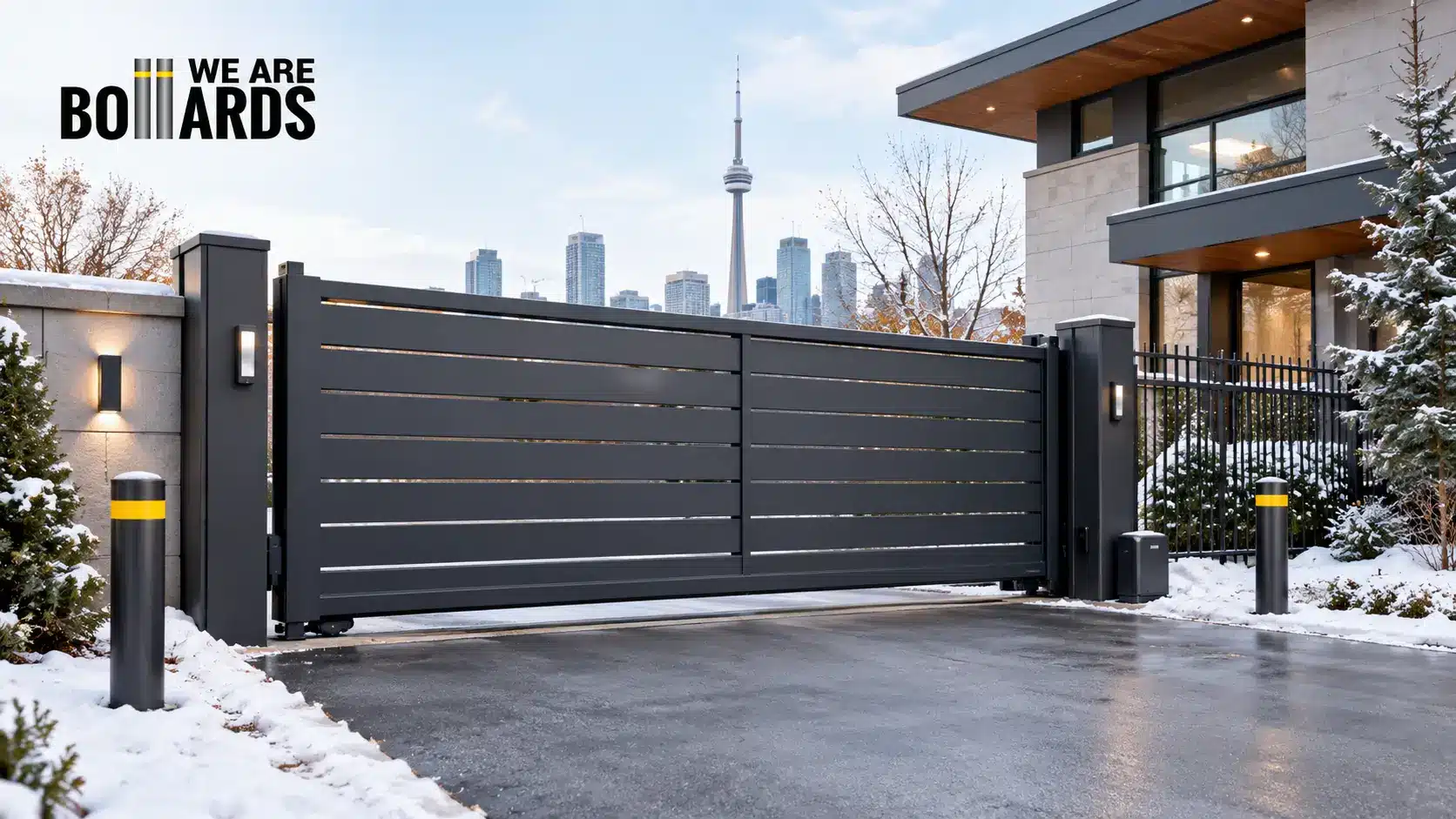
An automatic gate adds a motor and a control system on top of a regular gate. You open it with a remote, a keypad, an intercom, or your phone. The gate itself can be the exact same swing or slide gate — automation is just added on top.
So really, you’re not choosing between two totally different products. You’re deciding whether to add power and automation to a gate you’d likely want either way.
What Does Each One Cost?
Prices depend on the gate’s width, material, and whether power is already nearby, so treat these as general guidelines, not a quote.
Manual gates cost less. You’re only paying for the gate and its hardware — no motor, no wiring, no sensors.
Automatic gates cost more, for three reasons:
- The motor itself
- Bringing power to the gate (either running an electrical line, or installing solar panels and a battery)
- The safety sensors required by law (more on this below)
Automatic gates also cost a little more to own over time — a bit of electricity, occasional motor servicing, and eventually a motor that needs replacing. A manual gate has almost no ongoing cost beyond the odd drop of oil on the hinges.
How Do They Handle a Toronto Winter?
This is the part most articles skip — and it’s often the deciding factor for GTA homeowners.
Ice on the tracks. Sliding gates run along a track at ground level. That’s exactly where snow piles up and melts into ice overnight. If the track isn’t cleared or built with good drainage, the gate can jam during a freeze-thaw stretch — something Toronto gets a lot of every winter. Swing gates don’t have this problem since they don’t touch the ground.
Cold weather and batteries. If your automatic gate runs on solar power, the battery won’t hold as much charge in deep cold — the same way a car battery struggles in winter. A system built for our winters plans for this. One built for a milder climate might not.
Manual gates freeze too. Hinges can stiffen up in the cold, and a latch can ice over after freezing rain. The difference is a manual gate just gets harder to open by hand. An automatic gate might not open at all until it’s fixed — which matters a lot if it’s your only way in.
Road salt. Any driveway near the street gets hit with salt spray all winter. That’s tough on exposed metal — hinges, latches, motor housings. Stainless steel or properly coated hardware lasts much longer here, on either gate type.
Our advice: if you’re getting an automatic gate, ask your installer three things — how they handle ice on the track, how the battery performs in the cold, and whether there’s a manual override if the power goes out. That last one matters. You don’t want to be locked out of your own driveway during a snowstorm.
Is an Automatic Gate Safe?
Adding a motor to a gate turns it into a piece of machinery — and in Canada, powered gates are covered by a real safety standard called UL 325 (officially ANSI/CAN/UL 325). It’s recognized by the Standards Council of Canada and referenced in the Canadian Electrical Code.
In plain terms, this standard means an automatic gate has to be able to sense when something — a car, a person, a pet — is in its path, and stop or reverse before it causes harm. This usually means two separate safety devices working together, like a photo-eye sensor and a pressure-sensitive edge. (UL Solutions has more detail on this standard if you want to read further.)
This isn’t just paperwork — it’s the difference between a gate that stops itself before closing on a car bumper or a pet, and one that doesn’t. A manual gate doesn’t need this kind of safety system, simply because a person pushing a gate by hand can’t apply the same force as a motor.
If you’re getting quotes, it’s fair to ask whether the gate operator and sensors meet UL 325 for your type of property. A contractor who can answer that clearly is a good sign.
What to Think About Before You Install
Your driveway’s shape. Sliding gates need a straight, fairly flat stretch to run along. Many older Toronto driveways are sloped or uneven, which often suits a swing gate better.
Power access. No electricity near the gate? You’ll either need a new line run out to it, or a solar-powered system sized for our shorter winter daylight hours.
Room to swing. A swing gate needs open space to move — no parked car, wall, or slope in the way. Tight city driveways sometimes rule this out.
Frost and footings. Just like fence posts, gate posts need to be set below the frost line so they don’t shift when the ground freezes and thaws. This applies whether the gate is automatic or manual.
Pairing with a fence or bollards. A gate rarely stands alone. If you already have fencing or bollards, or you’re planning them, it’s worth designing the gate to match — same height, same materials, same layout. (See our guide on combining a gate and fence for full perimeter security.)
Keeping It Running: Maintenance
Manual gates need almost nothing: oil the hinges now and then, make sure the latch still closes properly, and check for rust — especially near the road where salt spray lands.
Automatic gates need all of that, plus:
- A yearly check on the motor and control box
- Testing the safety sensors to make sure they still work
- Replacing the battery every few years on solar systems
- Clearing and checking the track, especially after winter
Skipping sensor checks on an automatic gate isn’t just about convenience — it’s a real safety issue. That’s the trade-off with automation: more convenience, but a real ongoing commitment to upkeep.
So, Which One Should You Get?
Go automatic if:
- Someone in your household finds it hard to get out and open a gate by hand
- The gate gets used several times a day, by more than one driver
- It’s a business entrance with regular staff, deliveries, or visitors
- You want it linked to an intercom, camera, or access system
- You’re okay with the extra maintenance and cost
Go manual if:
- The gate doesn’t get opened very often
- You want the lowest cost, up front and long-term
- You’d rather have fewer things that can break
- It’s a side or back gate, not your main driveway entrance
- You don’t want to run new power out to the gate
Neither choice is a downgrade. A solid manual gate on a quiet driveway will often outlast — and out-value — an automatic gate that barely gets used. On a busy or commercial driveway, that math flips the other way.
Frequently Asked Questions
Will my automatic gate still work if the power goes out?
Only if it has a manual release or a battery backup built for outages. Ask about this before installation — it’s a real concern here, not a rare one.
Are automatic gates safe around kids and pets?
Yes, when they’re installed to meet the UL 325 safety standard — with working sensors that detect anything in the gate’s path and stop it. That protection only works if the sensors are installed right and checked regularly.
Can I add automation to my existing manual gate later?
Often, yes — if the gate and its posts are strong enough to handle a motor. It’s worth having an installer check this before assuming it’s a simple add-on.
Do I need a permit for a gate in Toronto or the GTA? It depends on your city and the scope of the work, especially if electrical work or new posts are involved. Check with your local building department before you start.
Swing or sliding gate — which handles winter better? Swing gates tend to do better, since they don’t have a ground-level track where ice and snow build up. Sliding gates work fine too, as long as the track is designed with proper drainage and kept clear.
Ready to Choose?
The honest answer is: it depends on how you use your driveway, not which option sounds fancier. Think about how often the gate opens, whether power is nearby, your driveway’s shape, and whether you already have a fence or bollards it needs to match.
If you’re weighing your options for a property in Toronto or the GTA, you can compare automatic and manual gates — including swing, sliding, and commercial gate setups built for homes and businesses across the region.