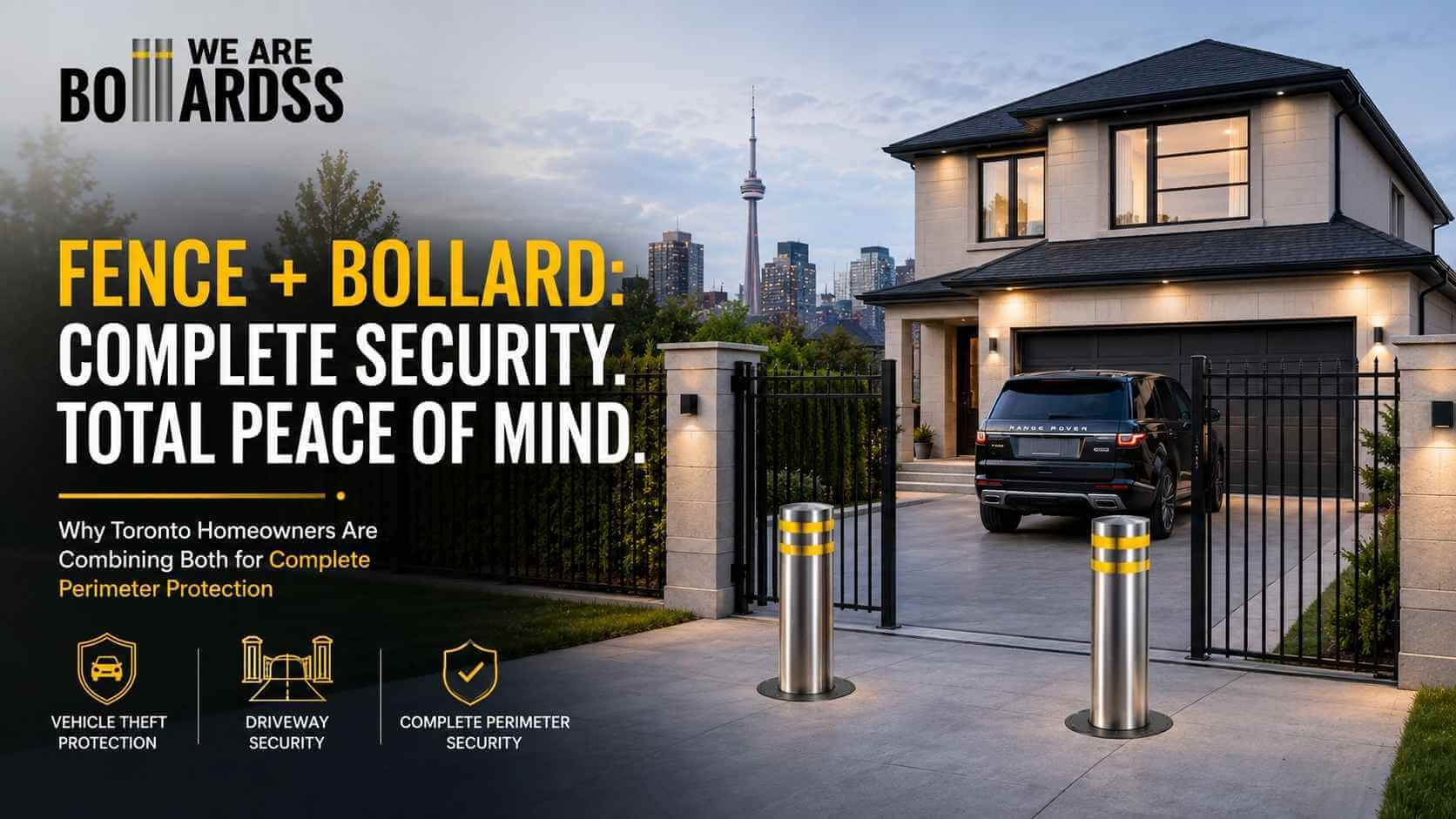
Toronto recorded 9,570 auto thefts in 2024 — and even with theft numbers trending down, Équité Association estimates auto theft still cost Canadians $900 million in insurance claims in 2025 alone. Organized crime groups are adapting with more sophisticated tactics. A camera won’t stop them. An alarm won’t either. Physical barriers will.
That’s why a growing number of homeowners across the GTA are no longer asking “fence or bollard?” — they’re installing both. And the results speak for themselves.
This guide explains exactly how a fence and bollard combination works, who it’s right for, what it costs in the Toronto market, and how to plan an installation that actually deters theft rather than just looking the part.What the Combination Actually Solves (That Neither Can Alone)
A fence and a bollard do fundamentally different jobs. Understanding the gap each fills is the starting point for any good perimeter security plan.
A security fence defines and controls your property boundary. It blocks pedestrian access, adds privacy, and signals clearly that your property is secured. A well-built steel or aluminum fence is an excellent deterrent for opportunistic intruders. What a fence cannot reliably stop is a determined vehicle. A car or truck driven into a standard residential fence will breach it.
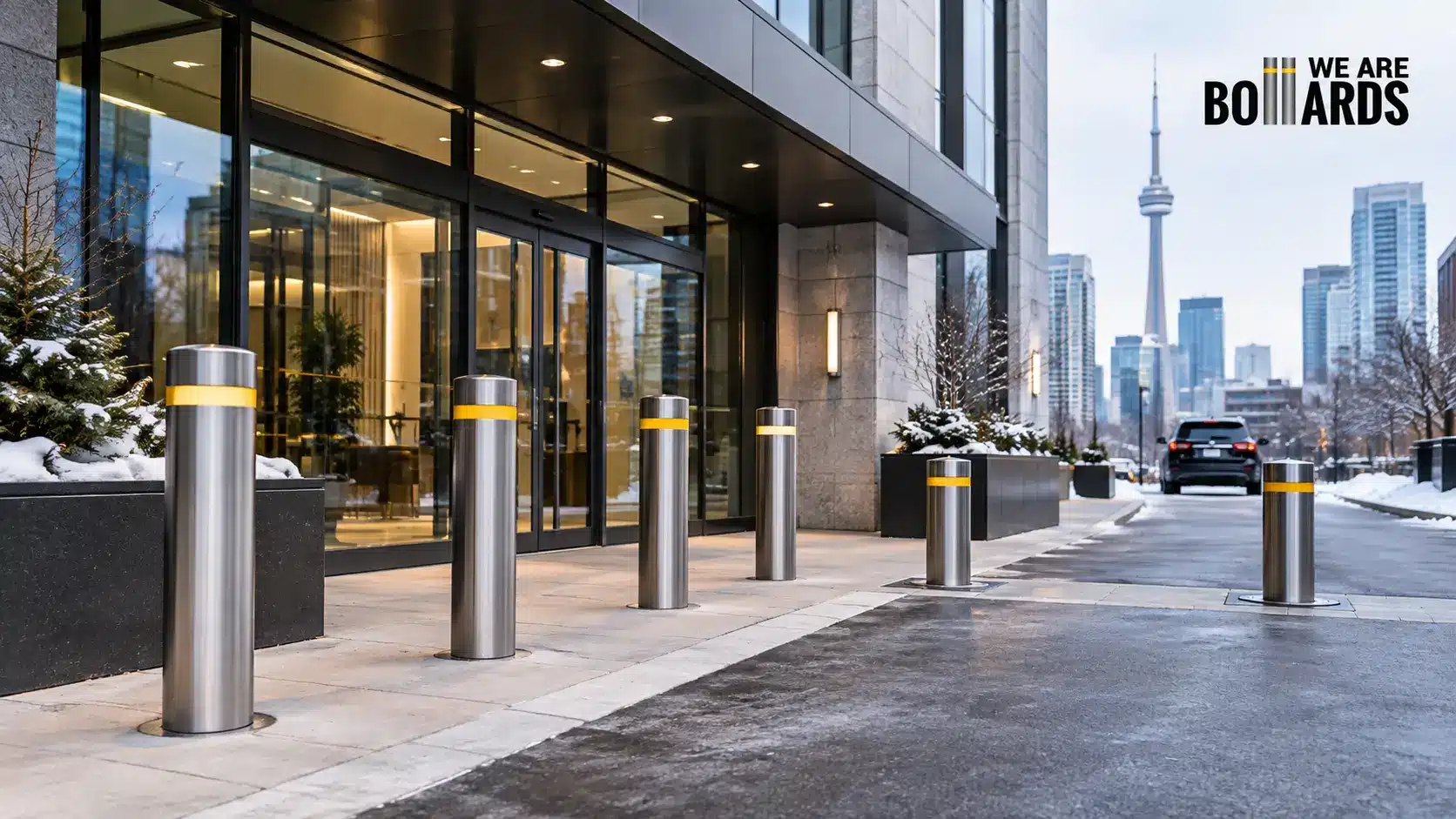
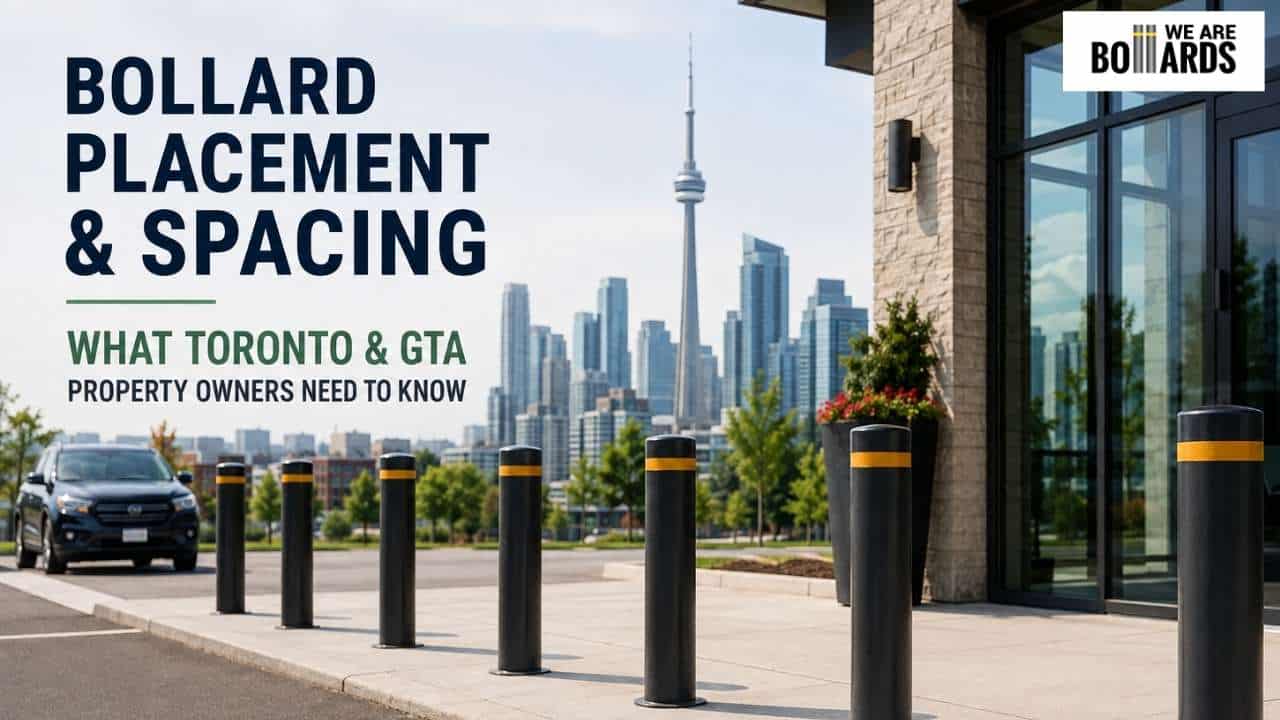
A bollard is purpose-built to stop vehicles. Installed at your driveway entrance, a bollard — whether fixed, manual retractable, or battery-powered automatic — creates a physical barrier that a vehicle cannot pass through. What a bollard cannot do is cover your full property perimeter. It secures one access point. The sides, rear yard, and property flanks remain exposed without additional fencing.
When you combine both, you close these gaps. The fence secures the perimeter; the bollard hardens the driveway — the single point where a vehicle theft actually begins. This is the layered perimeter security model used in commercial and industrial security design, now increasingly applied to residential properties in the GTA.
Why This Trend Is Growing Specifically in Toronto
Toronto’s vehicle theft problem has a specific character that makes the fence-and-bollard combination particularly effective here.
Most GTA vehicle thefts from residential properties follow a relay attack pattern: thieves use a signal amplifier to mimic your key fob from outside your home, unlock the car, and drive it away in under 60 seconds. The theft happens at the driveway. The car never needs to be broken into.
A bollard at the driveway entrance physically prevents the car from being driven away regardless of how sophisticated the attack is. There’s no electronic workaround for a steel post sunk into concrete.
The fence adds a second layer. Properties in high-theft neighbourhoods — including areas of North York, Etobicoke, Scarborough, and parts of the northwest GTA near Steeles and Highway 400, which Toronto Police data identifies as higher auto-theft zones — benefit from full perimeter control. A fence combined with a bollard forces a would-be thief to make noise, take time, and risk exposure. Thieves seek the path of least resistance. A fenced, bollarded driveway sends them elsewhere.
The Four Most Common Fence + Bollard Setups in Toronto
Every property is different, and the right combination depends on your driveway configuration, yard size, and primary security concern. These are the four layouts We Are Bollards installs most frequently across the GTA.
1. Aluminum Fence + Manual Retractable Bollard
Best for: Residential driveways with moderate daily vehicle use; homeowners who want a clean, low-maintenance setup.
An aluminum fence runs along the property perimeter. At the driveway entrance, one or two manual retractable bollards are sunk into the concrete. When you leave, you lift the bollard(s) and drive out; when you return and park, you lock them back down.
This is the most budget-conscious full perimeter setup. Aluminum fencing is corrosion-resistant, requires no painting, and holds up well in Canadian winters. Manual bollards have no electrical components, so there’s nothing to freeze or fail in a -40°C cold snap.
2. Steel Security Fence + Battery-Powered Automatic Bollard
Best for: Homeowners who want convenience alongside security; properties with frequent vehicle access.
A steel fence secures the perimeter with a more industrial aesthetic and greater impact resistance than aluminum. At the driveway, a battery-powered automatic bollard raises and lowers at the touch of a key fob — no bending down, no manual lifting, even in January.
Battery-powered bollards rated for -40°C (like those we install) operate through GTA winters without power line installation. This setup is increasingly popular in Vaughan, Richmond Hill, and Thornhill, where driveway widths tend to accommodate the setup cleanly.
3. Privacy Wood or Composite Fence + Fixed Bollards
Best for: Homeowners prioritizing backyard privacy and vehicle security at the front; properties where aesthetic is a key consideration.
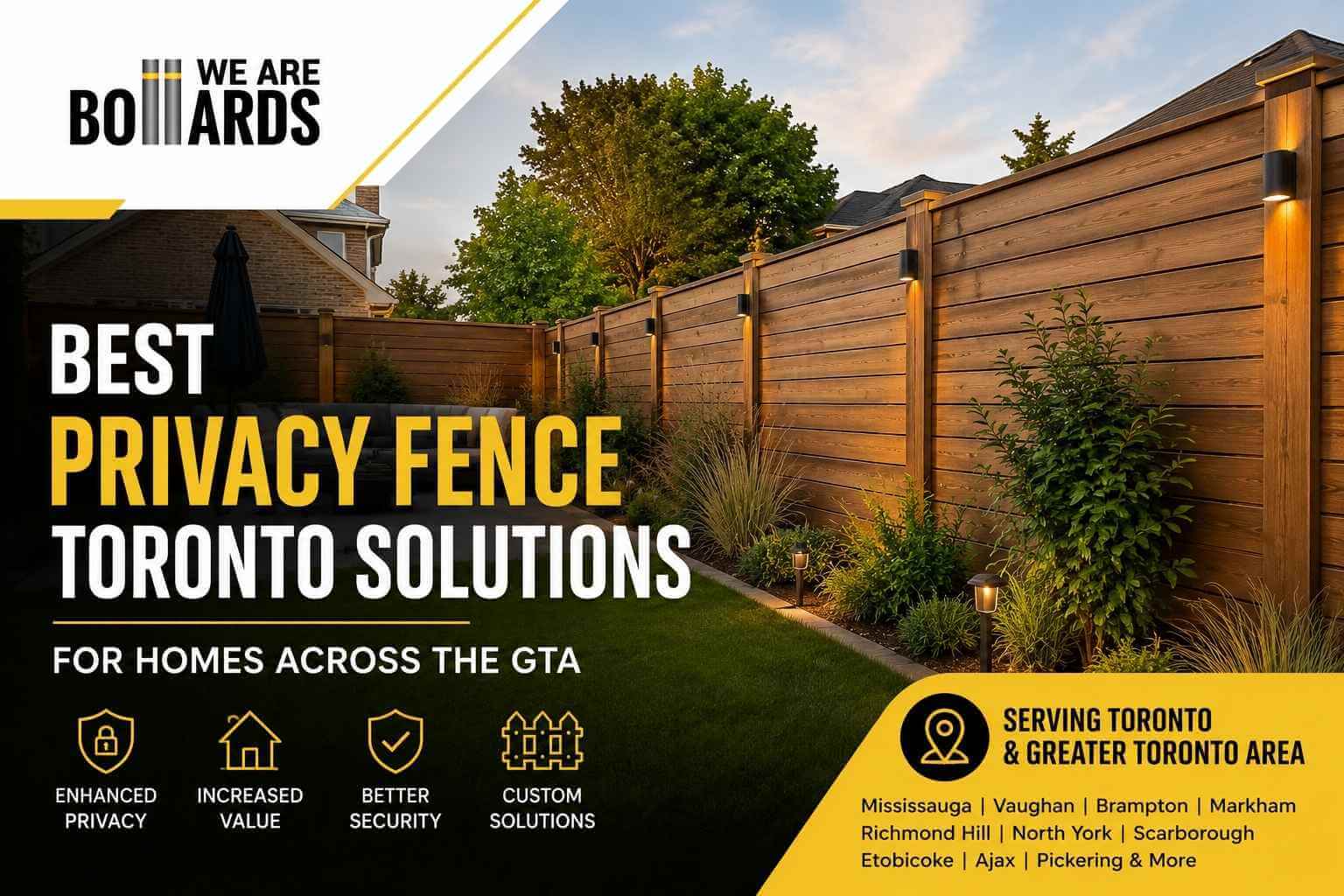
A tall wooden or composite privacy fence secures the rear and side yards. At the driveway, fixed steel bollards provide permanent, maximum-strength protection. Fixed bollards offer the highest impact resistance of any residential bollard type — they’re not retractable, but for homeowners with off-street parking who primarily move vehicles via a garage, this is the most effective and cost-efficient driveway hardening solution.
4. Full Steel Perimeter Fence + Gate + Bollards
Best for: High-value properties; homeowners wanting the highest tier of residential security available.
The complete solution: a steel security fence wraps the full property, a gate controls the driveway entrance with lock or remote access, and bollards are positioned just inside the gate for an additional arrest point. Even if someone bypasses the gate, the bollards prevent a vehicle from proceeding further.
This is the setup used in commercial security design, now being adopted at the residential level in areas with repeated theft incidents. We combine all three elements — fencing, gates, and bollards — in a single installation project, which simplifies coordination and ensures the components work together structurally.
Toronto Fence Bylaw: What You Need to Know Before Installing
Before any fence installation in Toronto or the broader GTA, you need to understand the local fence bylaw. Getting this wrong can mean tearing out a new fence and starting over.
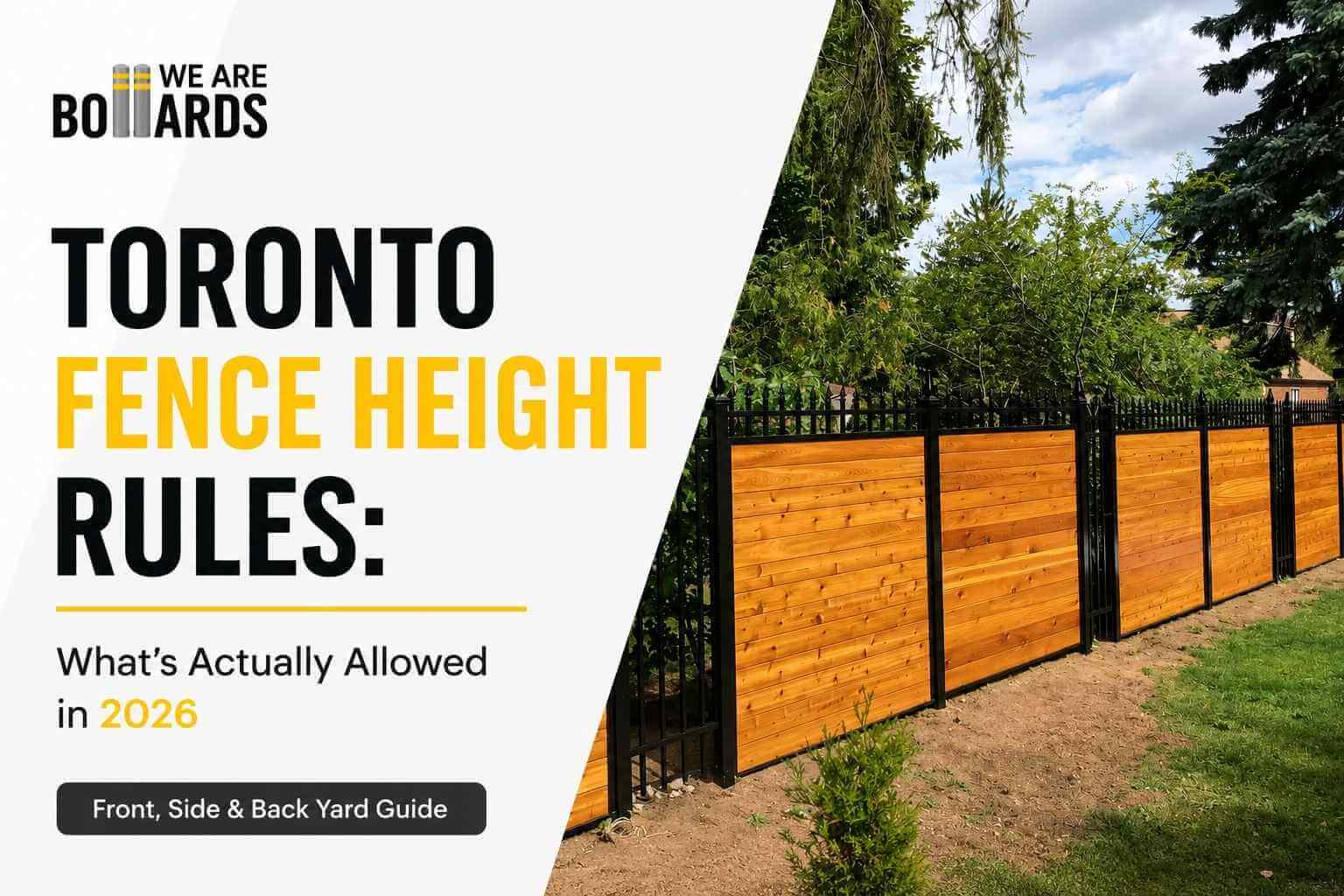
Key Toronto fence height rules:
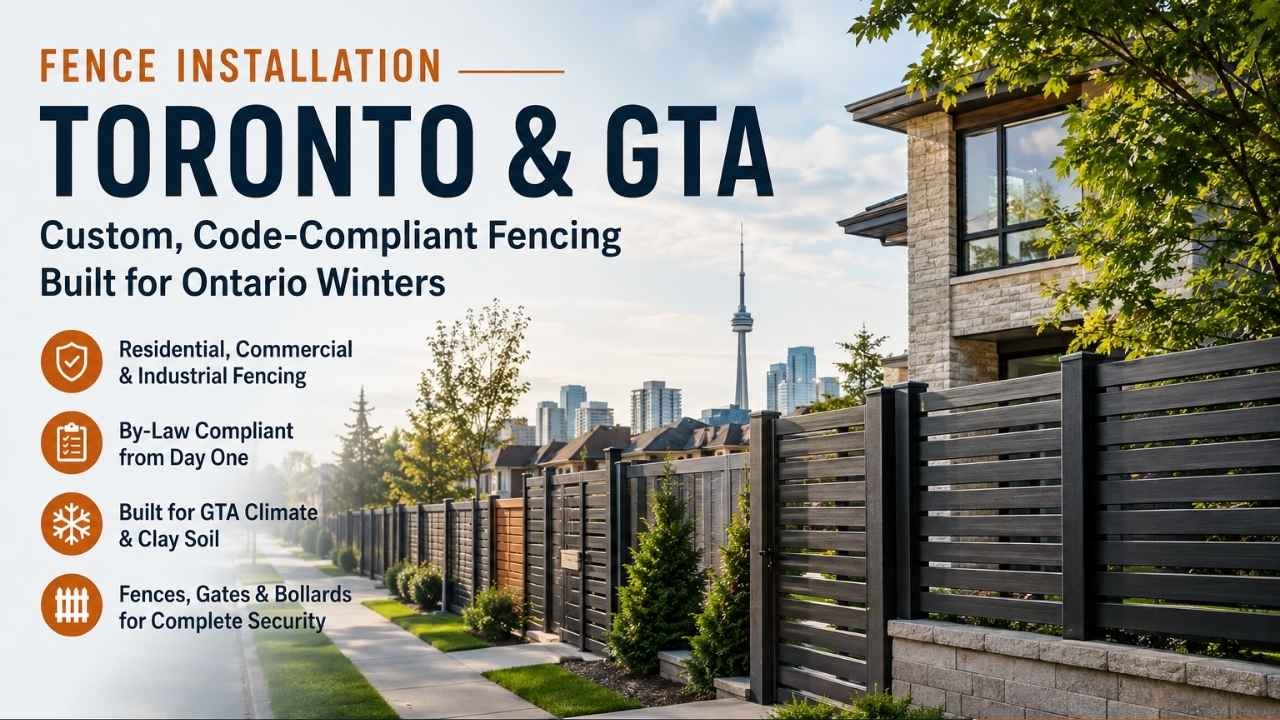
- Front yard: Maximum 1.2 metres (approximately 4 feet) for fences within 2.4 metres of the lot line facing a public street
- Side and rear yards: Up to 2 metres (approximately 6.5 feet) in most residential zones
- Pool enclosures: Require a separate permit and specific gate/latch specifications
Do bollards require a permit? In most Toronto-area municipalities, residential driveway bollards installed within your property line do not require a building permit. However, you must confirm the bollard placement does not encroach on the public sidewalk or boulevard. We Are Bollards handles this assessment as part of every installation consultation.
GTA municipality variations: Fence bylaws are not identical across the GTA. Vaughan, Mississauga, Markham, and Richmond Hill each have their own bylaws with slightly different height and setback rules. If your property is outside the City of Toronto boundary, verify the applicable municipal bylaw before ordering materials. You can check the City of Toronto’s official fence bylaw page for Toronto-specific rules.
How to Plan Your Fence + Bollard Project: A Step-by-Step Approach
Step 1: Identify your primary threat
Are you primarily concerned about vehicle theft from the driveway? Unauthorized access to your backyard? Noise and privacy? Your answer shapes which combination makes sense. Most GTA homeowners currently prioritizing vehicle theft prevention should focus the highest-specification bollard at the driveway entrance, with fencing completing the perimeter on either side.
Step 2: Walk your property line
Mark where your property ends and the public boulevard begins. Every element of your fence and every bollard must sit within your property. Encroachments onto city land require municipal approval and create legal exposure.
Step 3: Choose materials for the Canadian climate
Not all fencing and bollard materials perform equally in GTA winters. Key considerations:
- Aluminum fencing: Rust-proof, lightweight, holds colour well. Good for residential applications. Less impact-resistant than steel.
- Steel fencing: Higher strength, better impact resistance. Requires quality coating to prevent rust in freeze-thaw cycles.
- Wood fencing: Excellent privacy, natural aesthetic. Requires periodic maintenance (sealing, staining) to prevent rot in Ontario’s wet springs.
- Bollards: Stainless steel (316 grade) performs best in Canadian winters. Ensure any retractable bollard you purchase is temperature-rated to at least -40°C and dust/water resistant.
Step 4: Plan internal links between fence, gate, and bollard
The structural connection points matter. Fence posts need to be set at proper depth for frost heave (below the frost line, typically 4 feet in Toronto). Bollards need to be set in concrete at sufficient depth — generally 3 to 4 feet depending on soil conditions. If a gate is part of your design, it needs its own reinforced post installation. Trying to retrofit these elements after the fact is expensive and structurally compromised.
Step 5: Get a single-source installation quote
The biggest mistake homeowners make with combination security projects is hiring separate contractors for the fence and the bollards. When two contractors work independently, post placement, concrete footings, and surface finishes rarely align. We Are Bollards designs and installs fencing, gates, and bollards as an integrated project, which means one site visit, one concrete pour, and one finished product that looks and functions as a system.
What Does a Fence + Bollard Combination Cost in Toronto?
Pricing in the GTA varies based on your property dimensions, material choices, and the number of bollards required. As a general guide for residential projects:
- Aluminum fence (installed): Varies by linear footage and height; get a quote based on your specific perimeter
- Manual retractable bollard (installed): Competitive pricing with no electrical infrastructure required
- Battery-powered automatic bollard (installed): Higher upfront cost; no wiring needed
- Fixed bollard (installed): Most economical bollard option for permanent protection
We Are Bollards offers a price beat guarantee: if you receive a lower quote from another licensed installer for an equivalent product and installation scope, we’ll beat it by 3%. Request a quote here to get accurate pricing for your property.
Questions Toronto Homeowners Ask Before Combining Fence + Bollard
Will the bollard and fence look visually consistent?
Yes, if planned as a single project. We match materials and finishes so the bollard and fence posts complement each other rather than looking like afterthoughts. Steel bollards alongside a steel-panel fence, for instance, create a cohesive perimeter line.
Can I add bollards to an existing fence?
Yes. If you already have a perimeter fence and want to add bollard protection at the driveway, bollards can be retrofitted. The key is ensuring the installation depth doesn’t interfere with any existing underground utilities or fence footings. We conduct a site assessment before any installation.
How do retractable bollards hold up in Toronto winters?
Our bollards are rated to -40°C and built with water and ice resistance in mind. We recommend applying de-icing spray in winter and cleaning accumulated snow from the collar. A light lubrication two to three times a year keeps the mechanism operating smoothly. Unlike motorized gate systems with electrical motors exposed to the elements, manual and battery-powered bollards have minimal moving parts and have proved very reliable in Canadian conditions.
Is this overkill for a residential property?
Ten years ago, the answer might have been yes. Today, with 9,570 vehicle thefts recorded in Toronto in 2024 alone — even as overall theft rates trend down — and with organized theft rings continuously adapting their methods, layered physical security is a sound investment for any homeowner with a vehicle they cannot afford to lose. Insurance premiums across Ontario have also risen significantly in response to the theft crisis, so the cost of installation is increasingly offset by reduced premiums and the practical certainty of not losing a $50,000+ vehicle.
Do I need to notify my neighbours?
Under Toronto’s fence bylaw, you may be required to give notice to adjacent neighbours if the fence runs along a shared property line. The specifics depend on your property configuration. Your installer should walk you through this before installation begins.
We Are Bollards: Toronto’s Only Installer Covering Fences, Gates, and Bollards
Most security companies in Toronto specialize in one thing: either fencing or bollards. We Are Bollards is built to handle complete perimeter security — fencing, gates, and bollards — as a single integrated service for residential and commercial properties across Toronto and the GTA.
We serve: Toronto, Vaughan, Richmond Hill, Thornhill, Maple, Aurora, North York, Scarborough, Etobicoke, Mississauga, Markham, Pickering, Whitby, Brampton, Burlington, and all surrounding GTA municipalities.
All installations come with a 1-year warranty on parts and workmanship. Our price beat guarantee means you get the most competitive rate in the market without sacrificing quality.
Explore our fencing solutions →
See our bollard product range →
Request a free installation quote →
We Are Bollards serves residential and commercial properties across Toronto and the Greater Toronto Area. Call us at (647) 964-3020 or contact us online for a free consultation.